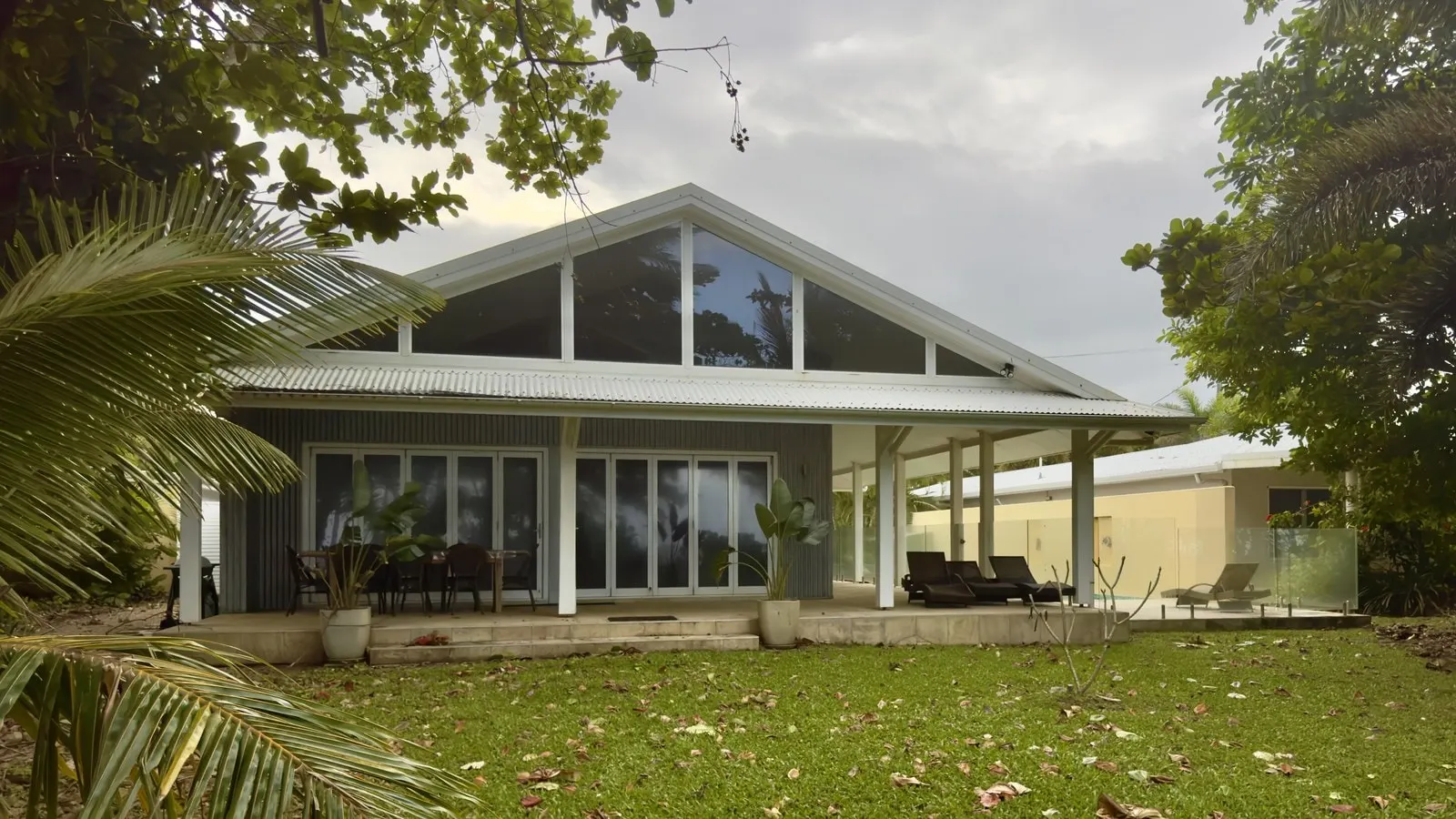

Townsville averages 8.5 hours of sunshine a day, and a home designed around that light, the sea breeze and the long dry season feels open, bright and easy to live in for most of the year. Contemporary design has plenty of tools for doing exactly that: open plans, louvres, high ceilings and clever shading, with good detailing ready for the shorter storm season. Here is a practical look at how they fit together, for anyone building, renovating or buying.
Sunshine, a long dry season and a short wet one
The Bureau of Meteorology's long-run records for Townsville Aero tell the sunshine story first. The city averages 8.5 hours of sunshine a day across the year, peaking at 9.8 hours in October. August averages 16.4 clear days, and July's mean minimum is a mild 13.9°C. The regional tourism body, Townsville North Queensland, sums it up as "tropical sea breezes, glorious winter days" and "more than 300 days of sunshine a year".
From June to September, no month averages more than about 20 mm of rain, and September averages just 9.9 mm. That is a long stretch of outdoor weather.
Most of the year's rain then arrives in a burst. Mean annual rainfall is 1,164.7 mm, with January averaging 274.4 mm, February 312.9 mm and March 197.9 mm. For a home, that means two design briefs in one: a long, bright dry season to enjoy with the doors open, and a shorter wet season to handle with confidence.
Start with the breeze
The Australian Government's Your Home guide says that in warm humid climates, orientation is about access to cooling breezes and shade. Near the coast, breezes are generally onshore, so it pays to find out which way they come from on your site before the design is fixed. Your Home adds a useful point: for breeze collection, the design of the openings matters more than perfect orientation.
Contemporary plans do this well. A few ideas that suit the dry tropics:
- Open plans, one room deep. Your Home notes that cool breezes work best in narrow or open-plan layouts, and that single-depth rooms are ideal in warmer climates.
- Openings that line up. Larger openings on the leeward side and smaller ones on the windward side help draw air through, and openings on opposite or adjacent walls give breezes a path.
- Louvres and big sliding doors. For free-running homes in hot humid climates, Your Home recommends windows that are fully openable, such as louvre or casement windows. A louvre or awning panel above an internal door lets air move while keeping privacy.
- Height to let heat out. High or raked ceilings and high-level openings, such as clerestory windows or roof vents, let warm air escape, which draws cooler air in below.
- A lifted floor. Elevating the building lets air flow beneath the floor.
- Ceiling fans. Your Home recommends them in all rooms, and they keep the air moving on still evenings.
Shade, built in
Modern shading is part of the architecture rather than an add-on. In hot humid climates, Your Home advises shading the walls year round and considering shading the whole roof, and it recommends shaded outdoor living areas. Deep eaves, cantilevered roofs and operable external screens do the job neatly, and Your Home notes that light colours on roofs and walls help too. A well-ventilated roof space acts as a buffer between the roof and the rooms below.
What it looks like in practice
Your Home's Cairns case study is a good example of a contemporary tropical home in North Queensland. It is two pavilions linked by a covered breezeway, with large sliding doors, louvre windows, high clerestory louvres along the spine of the house as a thermal vent, large overhangs and pull-down screens. The house is elevated on a lightweight steel platform, uses ceiling fans, and its split-system air conditioners are rarely used. It also complies with the cyclone requirements for a C2 region. The owner describes it as an improved and updated version of a traditional Queenslander.
Storm season, handled with confidence
The wet season is also cyclone season, and here the building rules are refreshingly clear. The Queensland Reconstruction Authority's guidance explains that coastal areas north of Bundaberg are classified as Wind Region C, and homes there are designed to resist winds of 250 km/h, which the Bureau of Meteorology classifies as a mid-category four.
Within that region, each site receives its own classification from C1 to C4, depending on exposure. The guide offers a memorable rule of thumb: "the better the view, the higher the wind classification." A hillside home looking out to sea will need stronger details than one tucked among neighbours on flat ground.
Three practical takeaways from the guidance:
- The correct wind classification should appear on the building plans or contract, and all windows and garage doors must be rated to it.
- You can ask your builder to use the details for a higher classification than the minimum, for example C2 details on a C1 site, for extra peace of mind.
- Roof ventilators deserve a conversation. The QRA notes that whirlybirds can be damaged by wind or debris and let wind and water into the roof, so ask how any roof vents are detailed for your classification.
Sites close to a shoreline or tidal creek also need features for storm tide, which the QRA covers in a companion guide.
Questions worth asking before you sign
Whether you are building new or buying an established home:
- What wind classification applies to this site, and where is it shown on the plans?
- Are the windows, sliding doors, louvres and garage door rated to that classification?
- Which way do the afternoon breezes come from, and do the openings line up to catch them?
- Where does the heat go? Look for high-level openings, a ventilated roof space and ceiling fans.
- Is there a shaded outdoor room that will be usable from May to October?
- How does the roof shed a February downpour, and where does the water go?
A climate worth designing for
Townsville's climate is one of its best features. Long, bright dry seasons, mild winter nights and a wet season that the building system is well prepared for make it a rewarding place to build thoughtfully. Get the breeze, the shade and the wind rating right, and a modern home will repay you every day of the year.
Sources
- Bureau of Meteorology, Climate statistics for Australian locations: Townsville Aero (032040), all years of record (rainfall 1940–2026; sunshine 1957–2016; clear days 1940–2010): https://www.bom.gov.au/climate/averages/tables/cw_032040_All.shtml
- Townsville North Queensland, Travel Information: https://www.townsvillenorthqueensland.com.au/plan-your-visit/travel-information/
- Your Home (Australian Government), Design for climate: https://www.yourhome.gov.au/passive-design/design-climate
- Your Home (Australian Government), Passive cooling: https://www.yourhome.gov.au/passive-design/passive-cooling
- Your Home (Australian Government), Orientation: https://www.yourhome.gov.au/passive-design/orientation
- Your Home (Australian Government), Shading: https://www.yourhome.gov.au/passive-design/shading
- Your Home (Australian Government), Cairns, Queensland case study: https://www.yourhome.gov.au/case-studies/hot-humid/cairns-queensland
- Queensland Reconstruction Authority, Cyclone Resilient Building Guidance for Queensland Homes, December 2019: https://www.qra.qld.gov.au/sites/default/files/2019-12/0321%20Cyclone%20Resilient%20Building%20Guidance%20for%20Qld%20Homes%20FINAL.pdf
Header photo: Chris Olszewski (Kgbo) / Wikimedia Commons, CC BY-SA 4.0. A modern beachfront home at Mission Beach, North Queensland; not a Centurion project.